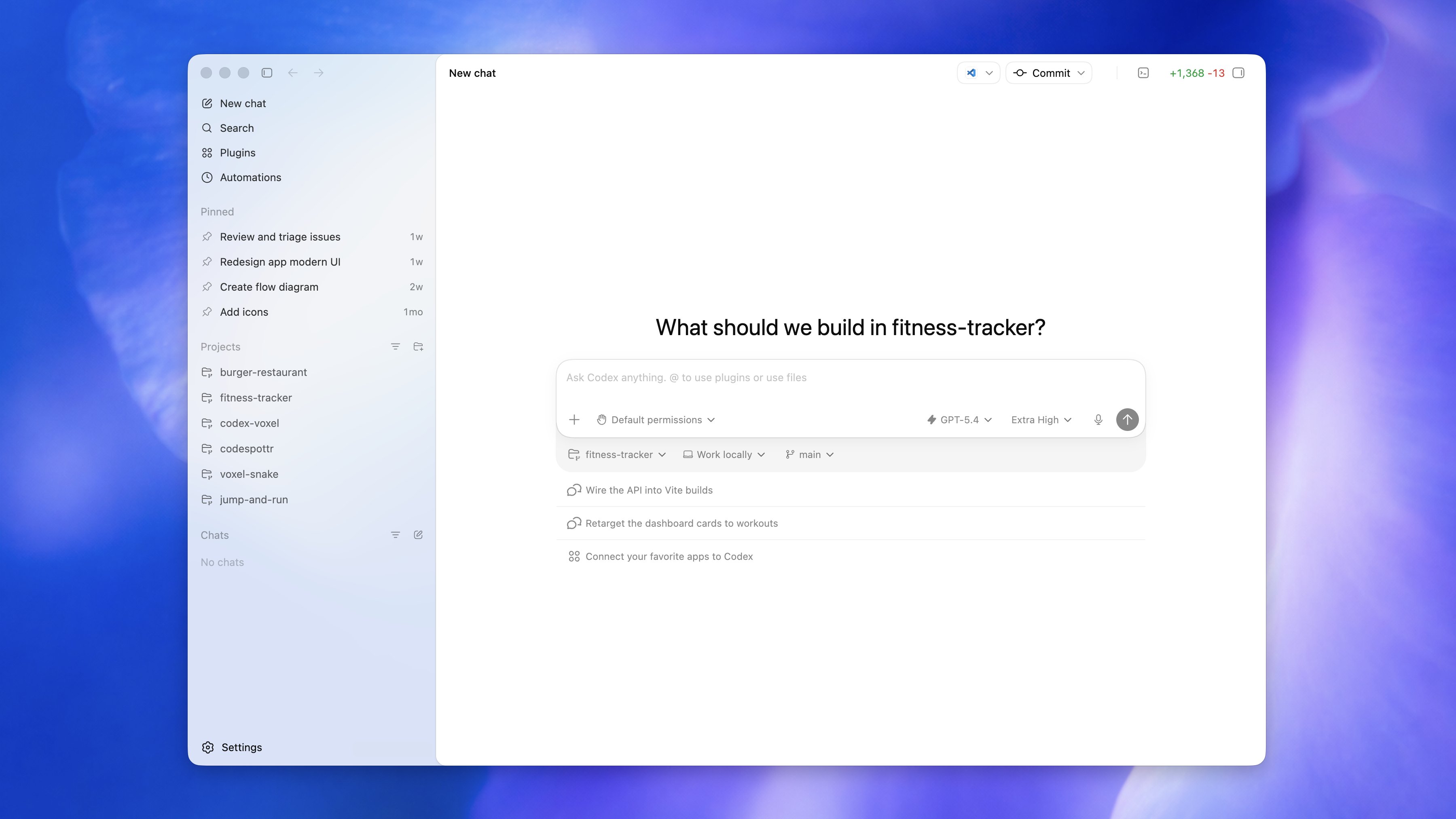
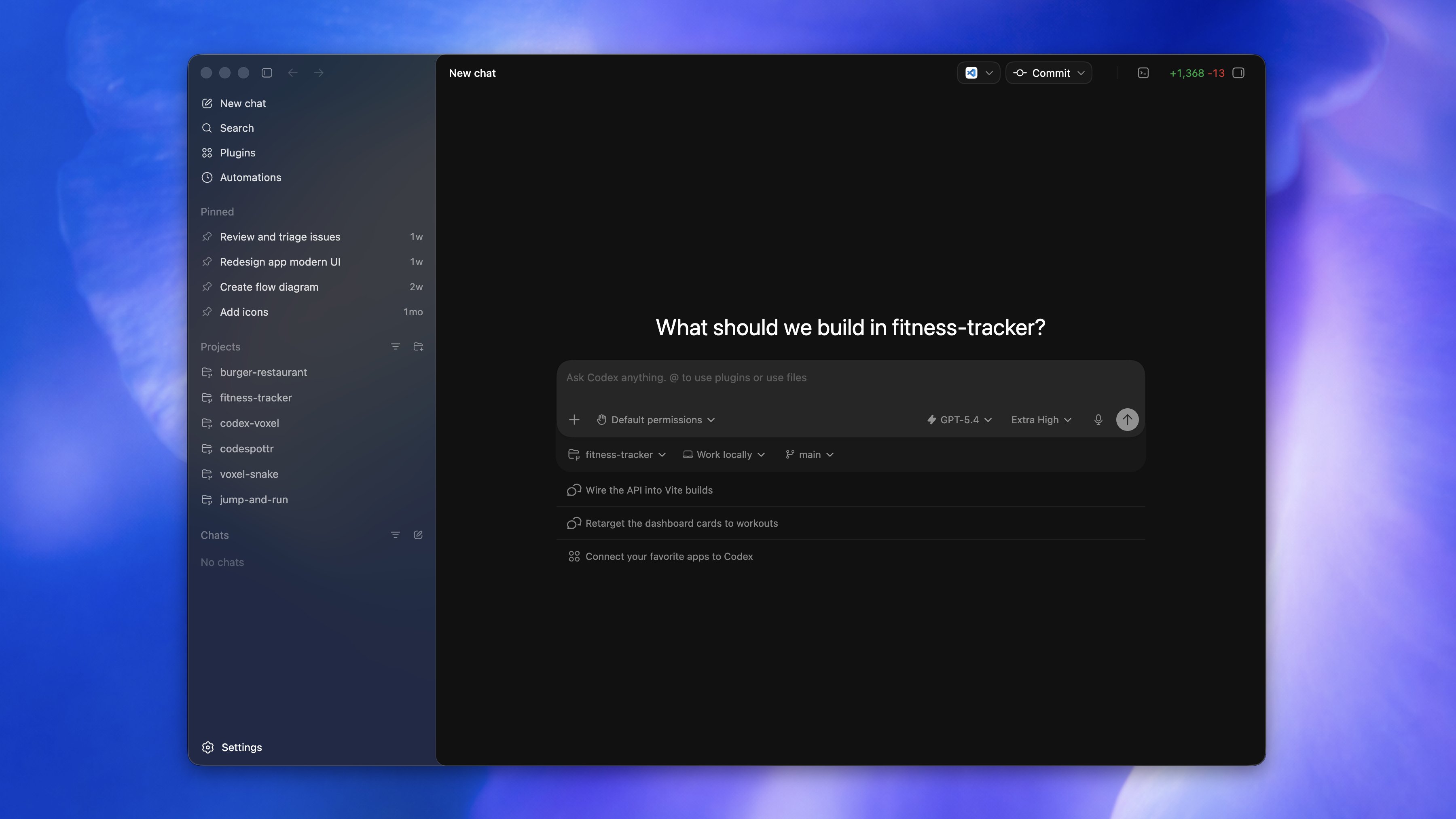
This weekly digest highlights ZeroTwo and ZeroCode features that can change how you
work, with examples and links to learn more. For every versioned update, bug fix,
and minor improvement, see the ZeroCode changelog.
July 27–31, 2026
Use GPT-5.6 Terra and Luna at lower rates
GPT-5.6 Terra now costs 20% less, and GPT-5.6 Luna costs 80% less. Input,
cached input, and output rates decreased by the same proportions. The updated
usage limits and rates make Terra a stronger fit for everyday
work and Luna especially useful for focused coding and high-volume tasks.
Find useful context across your browser and open tabs
In the ZeroTwo desktop app, the built-in browser can find
pages from your browsing history or search Google directly from its address
bar. ZeroTwo can also search your browsing history when a task needs earlier
context.
The Chrome extension lets you mention open tabs,
bring selected page text into a side chat, ask questions about YouTube videos,
or select Ask ZeroTwo from a page’s context menu. Review and approve
requests to use browser history before ZeroTwo includes that information in a
task.
Review changes across repositories
When a local project contains more than one
folder, the
desktop app shows every repository and the lines changed in each one. Select
Review to inspect their diffs together without switching between separate
review views.
Refine generated images in your conversation
Open a generated image in the expanded viewer, then switch between
Focused view and Canvas view. Add comments across images, select the
versions you want to keep, and ask for targeted edits without leaving the chat.
Learn more about image generation.
Find chats that need your attention
The desktop app’s new Activity view brings together chats you recently
engaged with and work that needs your attention. Select the bell in the sidebar
to open the view.
Read the July 30 desktop release
notes.
Sign in with ZeroTwo is rolling out in beta to supported plugins and
partner sites, beginning with Airtable, GitLab, HubSpot, Notion, Supabase, and
Vercel. Use it to create or link a partner account with fewer steps, then start
working with that service in ZeroTwo or ZeroCode.
Partners receive only your name, email address, and profile picture when
available. Each plugin’s requested access still requires a separate review
and approval. Read the July 29 sign-in
announcement.
Collaborate in a dedicated academic research workspace
ZeroTwo for Academic Researchers
offers eligible faculty and postdoctoral researchers 12 months of complimentary
access to a dedicated ZeroTwo workspace. Approved teams can include up to five
verified researchers from the same institution and receive business data
protections and ZeroTwo Pro-level usage limits. Participants can use GPT-5.6
across ZeroTwo, ZeroTwo Work, and ZeroCode for research and coding workflows.
The program covers ZeroTwo access, not ZeroTwo API credits. Eligibility requires
institutional verification and a qualifying research
paper.
Continue ZeroCode tasks more reliably on iOS
ZeroTwo for iOS 1.2026.202 reconnects to tasks more reliably when you return to
the app or unlock your device with Face ID. Voice conversations use your chosen
ZeroTwo voice and show usage-limit warnings, while the composer now suggests
installed plugins and their skills consistently with the desktop app.
The release also improves pause and resume controls for goals, inline tables
and visual themes, large workspace diffs, selected-text references, and model
restoration. Read the July 27 iOS release
notes.
Compare security scans and manage findings
Hosted ZeroCode Security plugin releases 0.1.14 and 0.1.15 add scan comparisons,
false-positive feedback, scoped SECURITY.md policies, and clearer repository
and finding histories. You can select findings for tracking in Linear or GitHub
Issues, with ZeroCode reviewing the proposed action before you approve it.
Use the existing ZeroCode Security
workbench to review saved scans, findings,
repository history, and remediation in the desktop app. The hosted plugin
catalog offers version 0.1.15, while the public CLI plugin marketplace
offers version 0.1.11. Check the ZeroCode Security plugin
changelog before relying on a new feature.
Run security scans from the terminal, CI, or TypeScript
The public @openai/zerocode-security CLI and TypeScript SDK reached version
0.1.5, with release numbers separate from the ZeroCode Security plugin. Use the
package to run scans from the CLI, review pull-request
changes and upload SARIF results in CI, or run
resumable bulk scans across GitHub
repositories or a pinned CSV inventory.
The ZeroCode Security TypeScript SDK also lets you build
scanning, progress reporting, cost controls, and cancellation into your own
tools. The package is public, but running scans still requires ZeroCode Security
access. Some full-repository scans also require Trusted Access for Cyber.
Organize sessions and extend ZeroTwo desktop app 0.146.0
ZeroTwo desktop app 0.146.0
lets you name a new chat with /new release prep or /clear bug bash, pin
important threads, and switch between side conversations without closing them.
It also adds temporary conversation forks, standalone web search for compatible
custom model providers, executor-provided skills, and support for Agent Plugins
manifests, workspace plugin publishing, and other plugin marketplaces.
For custom clients, the app server can filter pinned
threads, create in-memory forks, inspect installed connector state, and read
connector metadata. Experimental WebSocket support also connects app-server to
remote Code Mode hosts. Review the
app-server security requirements
before exposing a remote connection. The release also improves proxy support,
MCP reconnection, terminal responsiveness, and Windows sandbox reliability.
Use GPT-5.6 Sol for hosted ZeroCode work
GPT-5.6 Sol now powers ZeroCode cloud code
review and quality assurance for eligible customers. Sol is the flagship
GPT-5.6 model for complex coding, research, computer use, and security work.
ZeroCode cloud selects its model automatically; Terra and Luna remain available on
supported local and web surfaces.
Prepare for the GPT-5.4 model retirement
On August 31, GPT-5.4 and GPT-5.4 mini will retire from ZeroCode for users signed
in with ZeroTwo. Replace gpt-5.4 with gpt-5.6-terra and gpt-5.4-mini
with gpt-5.6-luna in workspace defaults, saved model settings, managed
configurations, custom agents, and scheduled tasks.
The ZeroTwo API and ZeroCode sessions authenticated with an API key are not
affected. Review the deprecated ZeroCode models
and workspace model
availability before the
cutoff.
July 20–24, 2026
Talk through work with ZeroTwo Voice
ZeroTwo Voice, powered by GPT-Live, lets you talk
through work and coordinate tasks in Chat, Work, and ZeroCode in the ZeroTwo desktop
app. Start a new chat or task in voice mode, then ask ZeroTwo to start, check, or
steer work in other threads.
On macOS, say, “Take a look at this” to share an appshot of
your frontmost window when Screen context is on.
Voice is available with Plus, Pro, Business, Edu, and Enterprise plans in the
desktop app and through Remote on iOS.
Work across multiple folders in one local project
Local projects in the ZeroTwo desktop app can now include multiple related
folders. Choose a primary folder for new chats, Git operations, and automatic
discovery of AGENTS.md, skills, and config.toml. Secondary folders remain
available for file search, reading, and editing.
Open Edit project to add folders and choose the primary
folder.
Read the July 23 release notes.
July 13–17, 2026
Keep Work conversations and Projects together on desktop
The ZeroTwo desktop app now keeps Chat and Work conversations together in the
ZeroTwo view. Cloud Work conversations sync across web, mobile, and desktop;
local Work conversations stay on your computer. ZeroTwo Projects are available
in the desktop app. ZeroCode keeps its dedicated view and separate history for
developer workflows.
Compare ZeroTwo Work and ZeroCode on
desktop to choose the
view that fits your task.
Control parallel ZeroCode work with ZeroCode Micro
On July 15, ZeroTwo and Work Louder launched
ZeroCode Micro, a limited-run physical control
surface for ZeroCode in the ZeroTwo desktop app. Its Agent Keys show the status of
up to six chats and switch between them. Customizable Command Keys, an analog
stick, and a dial can trigger common actions or skills, start push-to-talk, and
adjust reasoning effort without leaving the keyboard.
Use GPT-5.6 through Amazon Bedrock
GPT-5.6 Sol, Terra, and Luna reached general availability through Amazon
Bedrock. Local ZeroTwo Work and ZeroCode surfaces can use the built-in
amazon-bedrock provider with a Bedrock API key or the
AWS SDK credential chain. This includes Work and ZeroCode in the ZeroTwo desktop
app, ZeroTwo desktop app, the desktop app, and the ZeroCode SDK.
Inspect ZeroCode task visualizations on iOS
ZeroTwo for iOS 1.2026.188 added inline visualizations to ZeroCode tasks and
improved creating and managing tasks from conversations, including reliable
links to newly created tasks. Read the
July 13 iOS release notes.
July 6–10, 2026
Take on ambitious work in ZeroTwo
ZeroTwo Work in ZeroTwo can gather context from
your files and plugins,
take action across workflows, and create reviewable documents, presentations,
spreadsheets, Sites, and other finished work. Powered by
GPT-5.6, it can break a goal into steps and work for hours while
you follow its progress, answer questions, change direction, and approve
important actions.
Scheduled tasks can keep that work moving when you’re away
by running once, on a schedule, when an event occurs, or while monitoring for
changes.
Choose the right GPT-5.6 model
The GPT-5.6 family offers three recommended
models across ZeroTwo Work, the ZeroTwo desktop app, and the ZeroCode IDE
extension. Sol is the flagship for complex coding, computer use, research, and
security work. Terra balances capability and cost for everyday work, while Luna
is the fastest, lowest-cost option. The default Power setting uses Sol with
medium reasoning.
Use ZeroCode in the ZeroTwo desktop app
On July 9, the ZeroCode app merged into the
ZeroTwo desktop app for macOS and Windows. ZeroCode keeps its
dedicated coding experience alongside ZeroTwo’s Chat and Work. The ZeroCode
experience includes inline editing in diffs, pull request review in the side panel, faster
Computer Use powered by GPT-5.6, and multi-repository
projects.
Existing ZeroCode app users can update as usual. You can make ZeroCode the default
view, use the ZeroCode logo as the app icon, and access desktop ZeroCode projects from
the ZeroTwo mobile app. The updated desktop app is available globally on every
ZeroTwo plan, including Free.
June 15–19, 2026
Turn demonstrated workflows into reusable skills
Record & Replay lets you show ZeroTwo or
ZeroCode a workflow on macOS and turn the demonstration into a reusable skill. Use
it for repetitive tasks that are easier to show than describe, then refine the
generated skill and replay it with new inputs. Initial availability excludes
the EEA, the United Kingdom, and Switzerland, and requires Computer Use.
Continue a chat on another host
Chat handoff
moves a chat and its Git state between your local computer and a connected
remote host. ZeroCode can create or reuse a worktree on the destination, transfer
the chat, and continue from the matching project.
The same desktop release adds bulk actions to scheduled run history, so
you can mark every run as read or archive eligible runs together.
Browse and review workspaces from iOS
In the ZeroTwo mobile app, Remote added a workspace file browser, a
directory picker for new chats, expand-and-collapse controls for diffs, and
per-chat or cross-chat MCP approval choices on iOS.
Computer Use, the Chrome extension, Memories, and Chronicle also began
rolling out to the EEA, the United Kingdom, and Switzerland. Memories remain
off by default in those regions, and Chronicle is an opt-in research preview
for ZeroTwo Pro subscribers on macOS.
Read the June 15 iOS,
June 16 availability, and
June 18 app release notes.
June 8–12, 2026
Debug web apps with Browser Developer mode
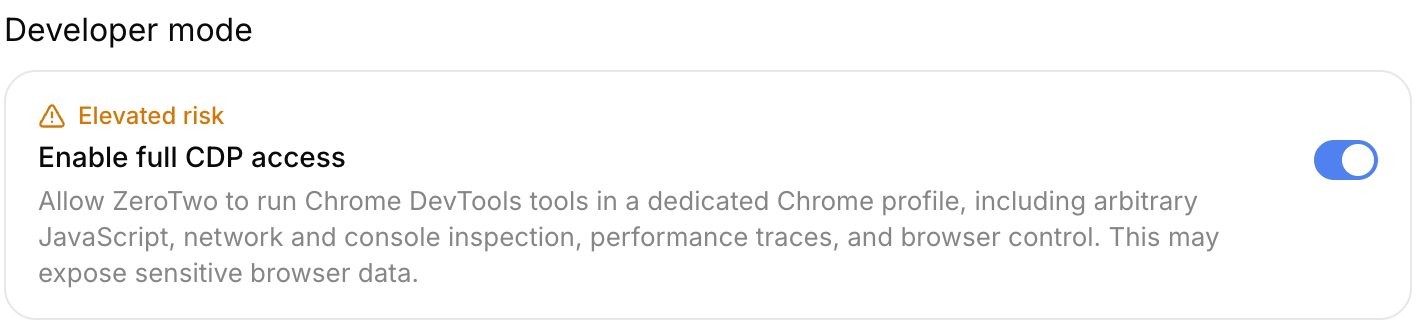
Developer mode gives ZeroCode controlled
access to Chrome DevTools Protocol capabilities in Chrome and the built-in
browser. ZeroCode can inspect network traffic, console output, runtime errors, and
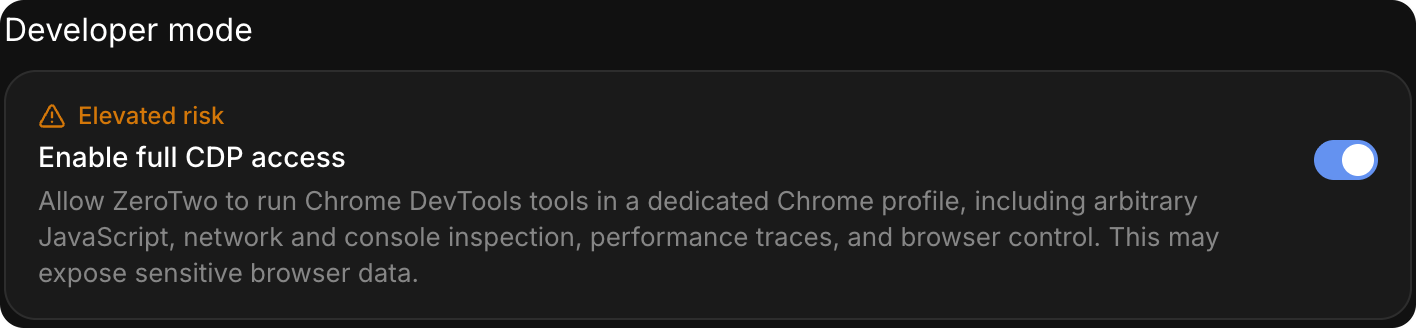
page state while it profiles or debugs your app. Under Developer mode in
Settings > Browser, turn on Enable full CDP access. ZeroCode asks for
explicit approval before it uses that access on a website.
Browser use is also up to twice as fast because CDP and DOM snapshot
optimizations reduce browser round trips.
Bring your setup to ZeroCode
New migration flows can import supported setup from other coding agents during
onboarding. The ZeroCode app also added /init for creating project instructions,
plus improved plugin management, browser diagnostics, and completed-chat
summaries.
Set up ZeroCode chats from iOS
Remote on iOS can now choose a branch, create a worktree, run an environment
setup script, manage goals, and add inline review comments.
Read the June 9 app,
June 9 iOS, and
June 11 app release notes.
June 1–5, 2026
Build and deploy websites with Sites
Sites lets ZeroTwo create, save, deploy, and inspect websites,
dashboards, internal tools, web apps, and games hosted by ZeroTwo. Sites has a
dedicated entry point in ZeroTwo on the web and desktop, where you can return to
projects and manage hosted environment values and secrets without assembling a
separate deployment stack.
Use ZeroCode with Amazon Bedrock
You can use ZeroCode with Amazon Bedrock for local
workflows with AWS-managed authentication, account controls, and billing.
Remote on iOS also added an optional in-app lock, follow-up behavior settings,
line wrapping for diffs, and SSH connections to Windows machines. The desktop
app added terminal placement controls and activity insights in the profile
view.
Read all June 2026 release notes.
May 25–29, 2026
Use Windows apps and control ZeroCode remotely
Computer use added support for
seeing, clicking, and typing in Windows desktop apps. Install the Computer Use
plugin before starting. On Windows, ZeroCode uses the active desktop and takes
over the foreground while the task runs. Remote connections also support
Windows. In the ZeroTwo mobile app, open Remote to start work on a Windows
device, or use a Mac running the ZeroTwo desktop app and check progress from
elsewhere.
Remote on iOS also added Spotlight and Shortcuts entry points, archived-chat
browsing, /side, and options to save or copy rendered images. The desktop app
added chat coordination for local projects and worktrees, content and
branch-name search for past chats, and consistent visual identifiers for
background subagents.
Read the May 25 iOS and
May 29 app release notes.
May 18–22, 2026
Give ZeroCode context from any Mac app with Appshots
Appshots send the frontmost app window to ZeroCode with a
screenshot and available text when you press both Command keys. ZeroCode gets
working context from design tools, dashboards, documents, and other apps
without requiring you to copy, paste, or describe what’s on screen.
Follow long-running goals
Goal mode left experimental status and is
available in the ZeroCode app, desktop app, and CLI for objectives that can take
hours or days. Locked use lets ZeroCode
continue approved computer-use work after a Mac locks, including through
Remote in the ZeroTwo mobile app. ZeroTwo Business workspaces can also
share reusable plugin bundles with workspace members.
Read the May 21 launch notes.
May 11–15, 2026
Continue desktop work from mobile
In the ZeroTwo mobile app, Remote connects to a Mac running the ZeroTwo
desktop app. Because work runs on the connected host, your projects, files,
credentials, plugins, skills, and configuration remain available when you
continue from your phone. See Remote connections
to set up a host and pick up work from another device.
Automate trusted workflows
Hooks reached general availability for running custom commands at key points in
the agent lifecycle. ZeroTwo Enterprise admins can also enable
ZeroCode access tokens for trusted scripts,
schedulers, and private CI runners. Enterprise guidance expanded to cover
managed setup and controls for ZeroCode.
Read the May 14 launch notes.
May 4–8, 2026
Work across browser tabs with the Chrome extension
The Chrome extension can work in
parallel across tabs in the background without taking over your browser. You
control which websites ZeroCode can use, making it practical to combine research,
data entry, and verification across web apps in one task.
The ZeroCode app also added dictation cleanup and a custom dictionary for names,
file paths, and code symbols. ZeroTwo Enterprise workspace owners can allow
members to create ZeroCode access tokens for
trusted, non-interactive local workflows.
Read the May 5 app,
May 5 access-token, and
ZeroCode for Chrome launch notes.
April 20–24, 2026
Use GPT-5.5 for complex work
GPT-5.5 arrived in ZeroCode as the recommended model for most
tasks, with strengths across implementation, debugging, testing, computer use,
research, and finished knowledge-work outputs.
Let ZeroCode operate the browser and review approvals
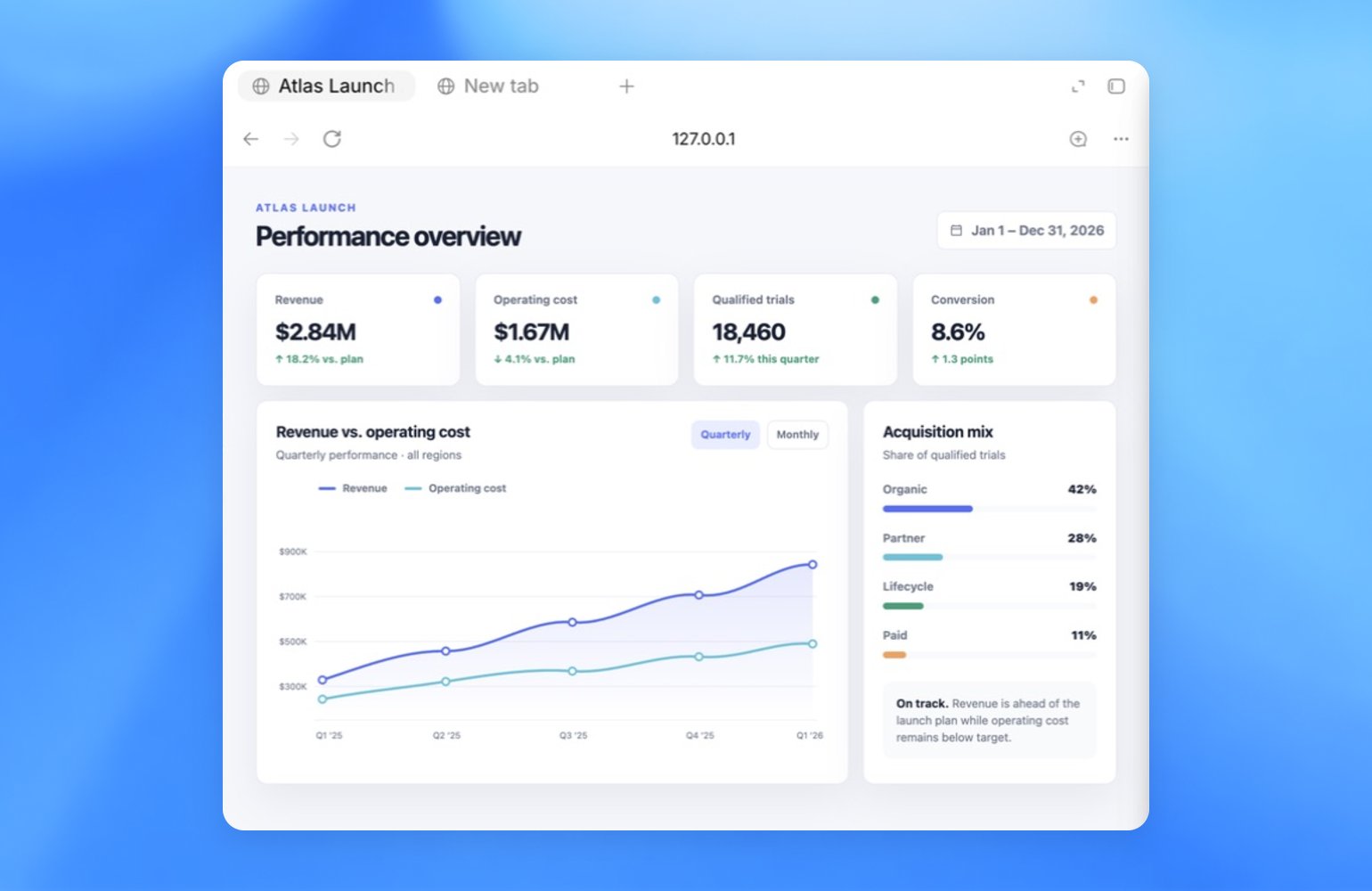
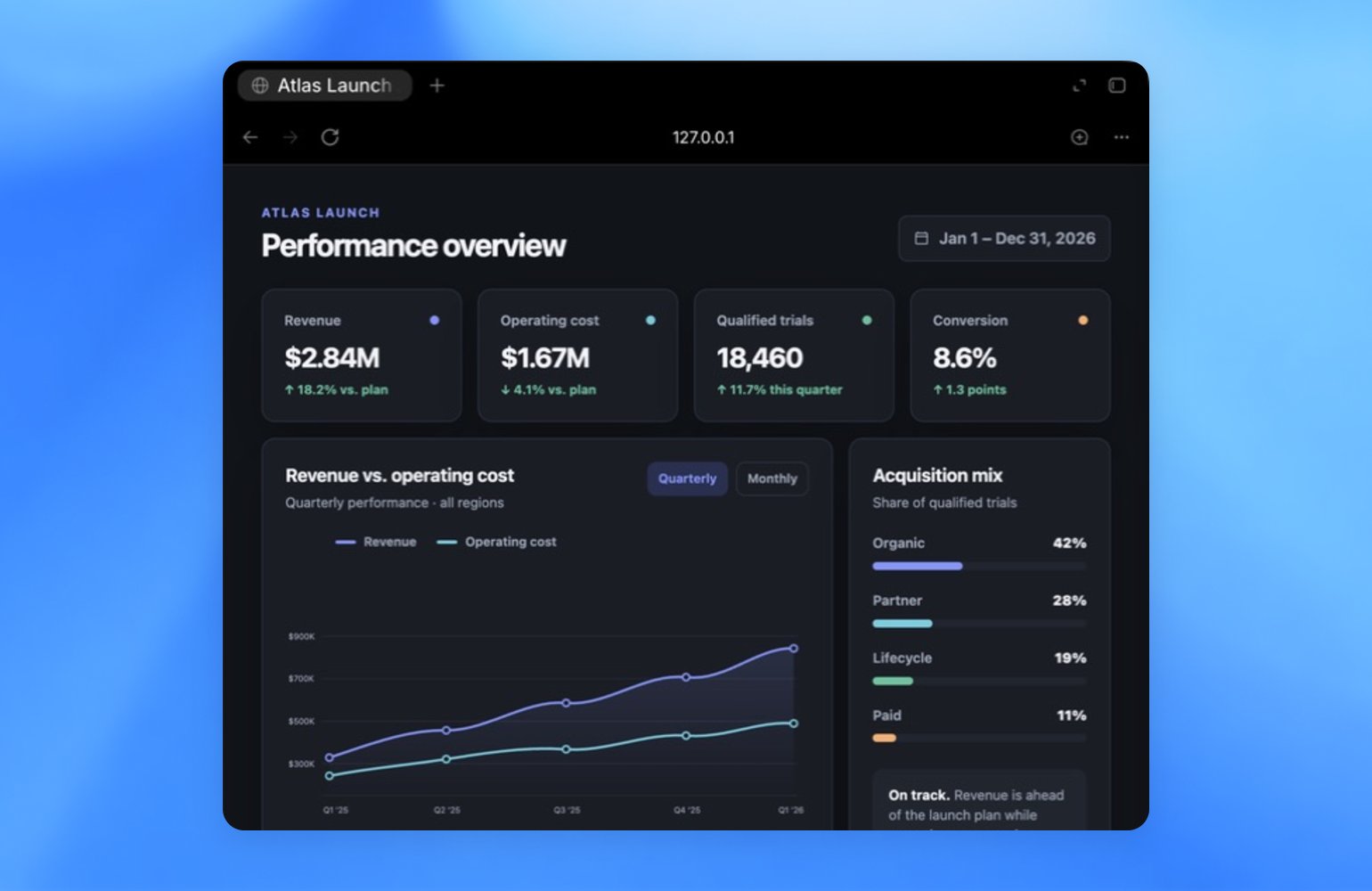
Computer Use in the built-in browser
lets ZeroCode click through local development servers and file-backed pages to
reproduce issues and verify fixes. Eligible approval requests can also go
through automatic approval review,
which shows the review status and risk before the action runs.
Read the April 23 launch notes.
April 13–17, 2026
Preview and operate work in one place
The built-in browser added live previews and page
comments, while Computer Use let ZeroCode see and
operate macOS apps. Together, they made visual implementation and end-to-end
verification part of the same task as the code change.
Start with a chat and keep it moving
Standalone chats made it
possible to begin without choosing a project folder. The same release added
scheduled tasks inside a chat,
pull-request context, richer file previews, and Memories for
work that spans chats.
Read the April 16 ZeroCode app release notes.
April 6–10, 2026
Review and ship pull requests in the app
The review experience added collapsible inline comments, inline and detached
review modes, and clearer Git and source context. Pull-request activity,
comments, and push choices then moved into the app alongside workspace file
tabs, so you could inspect a change and respond without switching tools.
Read the April 9 and
April 10 ZeroCode app release notes, or
learn how to review changes in the app.
March 23–27, 2026
Package workflows as plugins
Plugins launched as installable bundles of skills,
connectors, and MCP servers. They made complete workflows easier to discover,
install, and share, while redesigned plugin and skill pages made their contents
and status clearer. Search for past chats also arrived that week.
Read the task search,
plugins launch, and
ZeroCode app release notes.
March 16–20, 2026
You could fork a chat from an earlier message, making it easier to try a new
approach without losing the original path. Model and reasoning commands became
available while drafting, enabled skills appeared in the @ menu, and GPT-5.4
mini added a faster option for lighter tasks and subagents.
Read the GPT-5.4 mini,
chat control, and
skill menu release notes.
March 9–13, 2026
Schedule work with the right environment
Scheduled tasks could run locally or in a worktree
with an explicit model and reasoning level. Reusable templates made common
tasks faster to configure, and custom themes made the workspace easier to
personalize.
Let ZeroCode inspect terminal output
ZeroCode also learned to read the integrated terminal
for the current chat. It could inspect a running development server or build
output directly instead of asking you to paste it.
Read the March 11 and
March 12 ZeroCode app release notes.
March 2–6, 2026
Run ZeroCode natively on Windows
The ZeroCode app launched on Windows with native PowerShell
and sandbox support, plus worktrees, scheduled tasks, and skills. WSL remained
available for developers who preferred a Linux environment.
Move chats between Local and Worktree
Local and Worktree handoff
made it possible to move an active chat while preserving its context. GPT-5.4
also arrived in ZeroCode that week for coding, computer use, and longer-context
workflows.
Read the Windows launch,
worktree handoff, and
GPT-5.4 release notes.
February 9–13, 2026
Iterate in real time and branch an approach
GPT-5.3-ZeroCode-Spark entered research preview as a near-instant model for
real-time coding iteration. The app also added chat forking and a
floating, always-on-top chat window, so you could explore another approach or
keep ZeroCode beside an editor or browser.
Read the Spark and
ZeroCode app release notes, or see the
current model guide.
February 2–6, 2026
The ZeroCode app launches on macOS
The ZeroCode app launched as a desktop workspace for parallel project chats,
built-in Git review, worktrees, skills, scheduled tasks, and voice dictation.
Those capabilities now live in ZeroCode in the ZeroTwo desktop app.
Steer active work and add files
Mid-turn steering made it possible to redirect ZeroCode without stopping an
active response, and file attachments expanded beyond images. These patterns
became the foundation for steering and queuing
follow-ups with the context ZeroCode needs.
Read the ZeroCode app launch notes and
February 5 app release notes. Last modified on August 30, 2026