> ## Documentation Index
> Fetch the complete documentation index at: https://docs.zerotwo.ai/llms.txt
> Use this file to discover all available pages before exploring further.
# Computer Use
In supported regions, Computer Use in the ZeroTwo desktop app is available on
macOS and Windows with ZeroTwo Work and ZeroCode. Install the Computer Use
plugin. On macOS, grant Screen Recording and Accessibility permissions when
prompted.
With Computer Use, ZeroTwo can see and operate graphical user interfaces on macOS
or Windows. Use it for tasks where command-line tools or structured integrations
aren't enough, such as checking a desktop app, using a browser, changing app
settings, working with a data source that isn't available as a plugin, or
reproducing a bug that only happens in a graphical user interface.
Because Computer Use can affect app and system state outside your project
workspace, use it for scoped tasks and review permission prompts before
continuing.
## Set up Computer Use
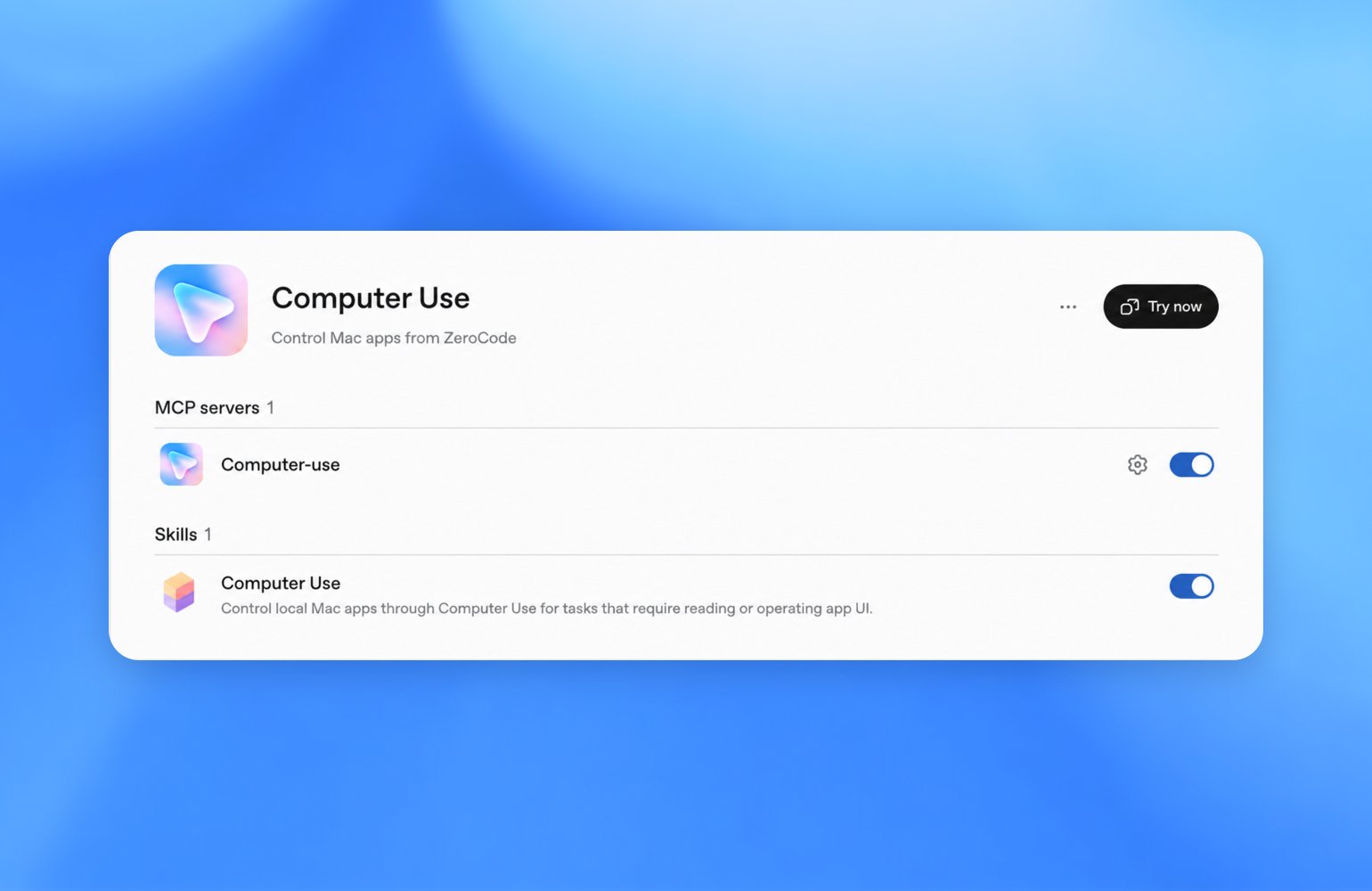
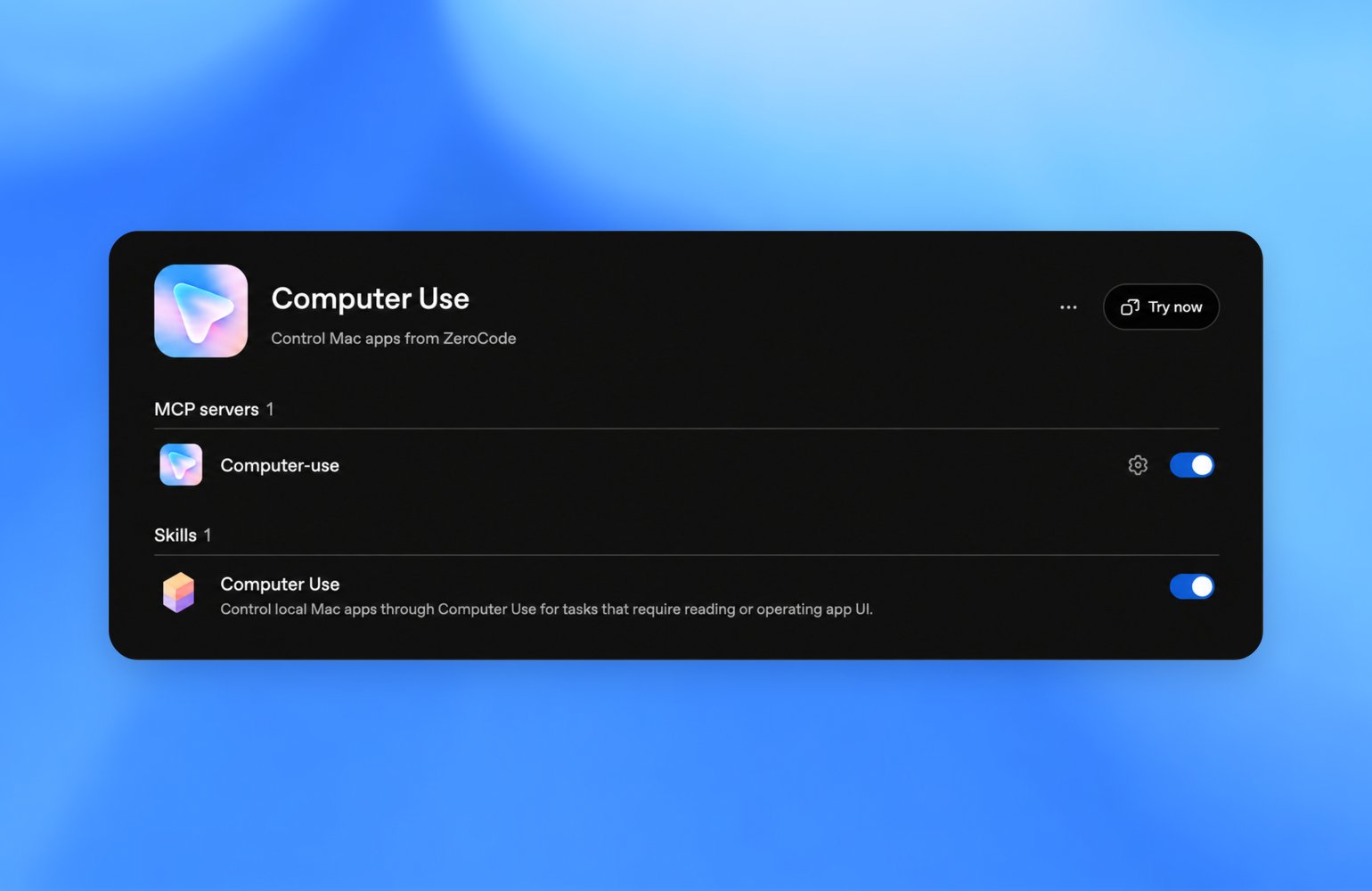
In the ZeroTwo desktop app, select ZeroTwo and switch to Work in the switcher, or select
ZeroCode. Open **Plugins > Computer
Use** and select **Install plugin** if prompted. If ZeroTwo shows **Enable**,
select it. Turn on the Computer Use server and skill toggles, then select **Try
now** to start.
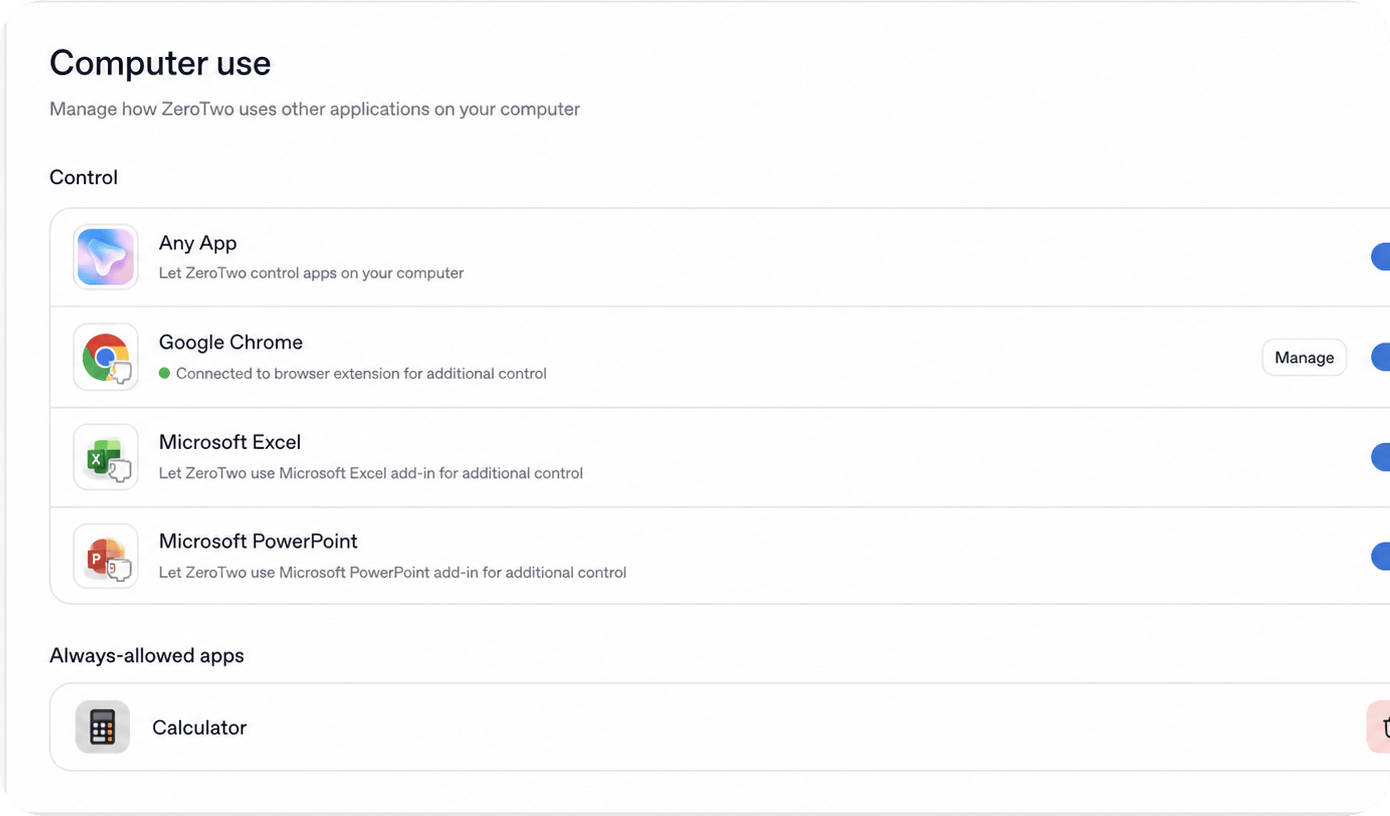
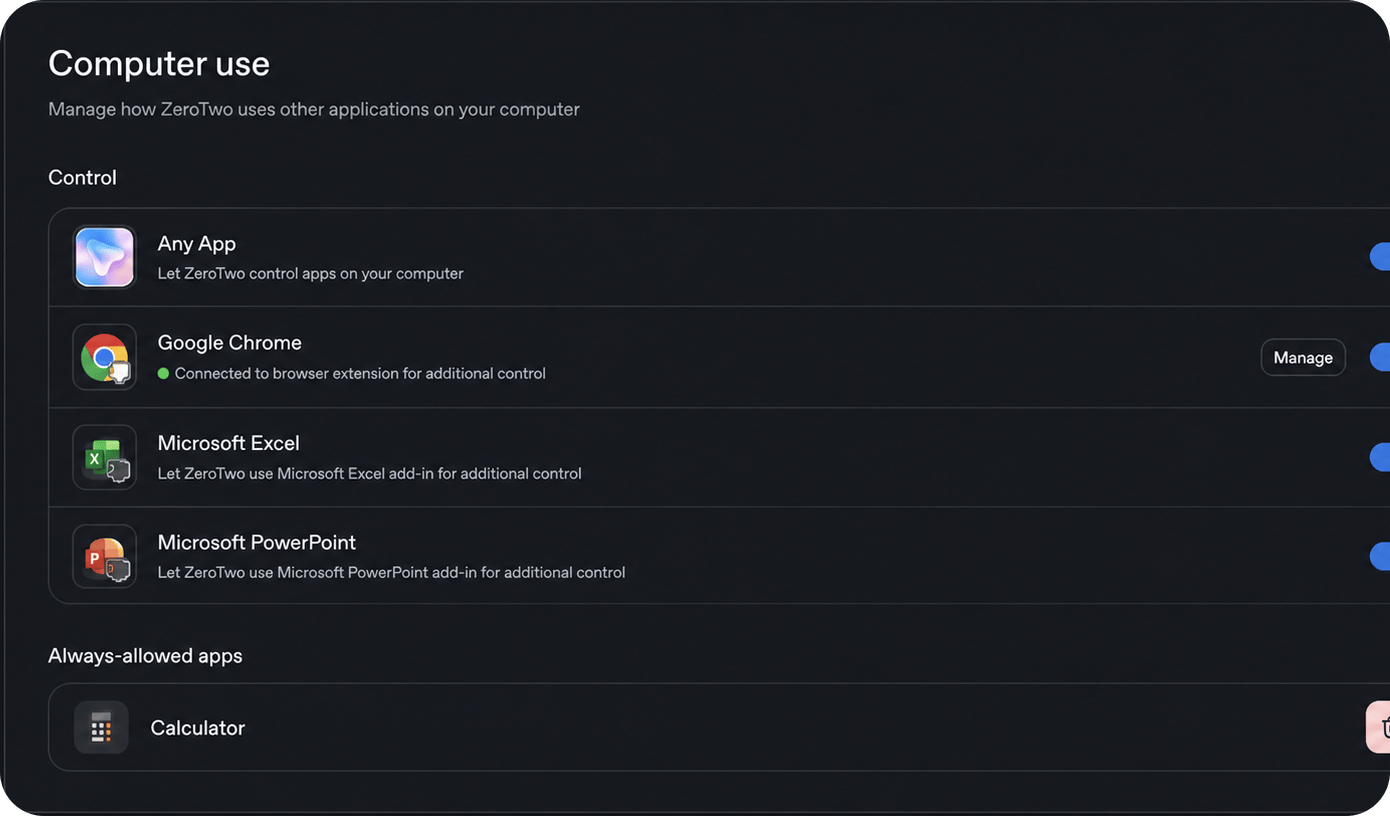
 Then open **Settings > Computer use** to review app access. Connected browser
controls show a **Manage** action. Apps you approve for future tasks appear in
the **Always-allowed apps** section.
Then open **Settings > Computer use** to review app access. Connected browser
controls show a **Manage** action. Apps you approve for future tasks appear in
the **Always-allowed apps** section.
 On Windows, keep the target app visible on the active desktop while the task
runs. On macOS, grant Screen Recording and Accessibility permissions when
prompted so ZeroTwo can see and interact with the target app.
On macOS, grant:
* **Screen Recording** permission so ZeroTwo can see the target app.
* **Accessibility** permission so ZeroTwo can click, type, and navigate.
## When to use Computer Use
Choose Computer Use when the task depends on a graphical user interface that's
hard to verify through files or command output alone.
Good fits include:
* Testing a macOS app, Windows app, iOS simulator flow, or another desktop app
that ZeroTwo is building.
* Performing a task that requires your web browser.
* Reproducing a bug that only appears in a graphical interface.
* Changing app settings that require clicking through a UI.
* Inspecting information in an app or data source that isn't available through a
plugin.
* On macOS, running a scoped task in the background while you keep working
elsewhere.
* Executing a workflow that spans more than one app.
For web apps you are building locally, use the
[built-in browser](/browser) first.
### Windows foreground use
On Windows, Computer Use runs on the active desktop. It can't operate in the
background while you keep using the same Windows session, so expect ZeroTwo to
move the pointer, type, and take over the foreground while the task runs.
For Windows tasks that should continue while you step away, keep the Windows
device unlocked and connected to the internet. Use
[remote control](/remote-connections) from your phone to check progress
or send follow-up instructions, or run the ZeroTwo desktop app inside a Windows virtual
machine so Computer Use takes over the VM instead of your main desktop.
## Start a Computer Use task
Mention `@Computer` or `@AppName` in your prompt, or ask ZeroTwo to use Computer
Use. Describe the exact app, window, or flow ZeroTwo should operate.
```text theme={null}
Open the app with Computer Use, reproduce the onboarding bug, and fix the
smallest code path that causes it. After each change, run the same UI flow
again.
```
```text theme={null}
Open @Chrome and verify the checkout page still works after the latest changes.
```
If the target app exposes a dedicated plugin or MCP server, prefer that
structured integration for data access and repeatable operations. Choose
Computer Use when ZeroTwo needs to inspect or operate the app visually.
## Permissions and approvals
System permissions for Computer Use are separate from app approvals in ZeroTwo.
On macOS, Screen Recording and Accessibility permissions let ZeroTwo see and
operate apps. App approvals determine which apps you allow ZeroTwo to use. File
reads, file edits, and shell commands still follow the sandbox and approval
settings for the task.
With Computer Use, ZeroTwo can see and take action only in the apps you allow.
During a task, ZeroTwo asks for your permission before it can use an app on your
computer. You can choose **Always allow** so ZeroTwo can use that app in the future
without asking again. You can remove apps from the **Always allow** list in the
**Computer Use** section of the ZeroTwo desktop app settings.
On Windows, keep the target app visible on the active desktop while the task
runs. On macOS, grant Screen Recording and Accessibility permissions when
prompted so ZeroTwo can see and interact with the target app.
On macOS, grant:
* **Screen Recording** permission so ZeroTwo can see the target app.
* **Accessibility** permission so ZeroTwo can click, type, and navigate.
## When to use Computer Use
Choose Computer Use when the task depends on a graphical user interface that's
hard to verify through files or command output alone.
Good fits include:
* Testing a macOS app, Windows app, iOS simulator flow, or another desktop app
that ZeroTwo is building.
* Performing a task that requires your web browser.
* Reproducing a bug that only appears in a graphical interface.
* Changing app settings that require clicking through a UI.
* Inspecting information in an app or data source that isn't available through a
plugin.
* On macOS, running a scoped task in the background while you keep working
elsewhere.
* Executing a workflow that spans more than one app.
For web apps you are building locally, use the
[built-in browser](/browser) first.
### Windows foreground use
On Windows, Computer Use runs on the active desktop. It can't operate in the
background while you keep using the same Windows session, so expect ZeroTwo to
move the pointer, type, and take over the foreground while the task runs.
For Windows tasks that should continue while you step away, keep the Windows
device unlocked and connected to the internet. Use
[remote control](/remote-connections) from your phone to check progress
or send follow-up instructions, or run the ZeroTwo desktop app inside a Windows virtual
machine so Computer Use takes over the VM instead of your main desktop.
## Start a Computer Use task
Mention `@Computer` or `@AppName` in your prompt, or ask ZeroTwo to use Computer
Use. Describe the exact app, window, or flow ZeroTwo should operate.
```text theme={null}
Open the app with Computer Use, reproduce the onboarding bug, and fix the
smallest code path that causes it. After each change, run the same UI flow
again.
```
```text theme={null}
Open @Chrome and verify the checkout page still works after the latest changes.
```
If the target app exposes a dedicated plugin or MCP server, prefer that
structured integration for data access and repeatable operations. Choose
Computer Use when ZeroTwo needs to inspect or operate the app visually.
## Permissions and approvals
System permissions for Computer Use are separate from app approvals in ZeroTwo.
On macOS, Screen Recording and Accessibility permissions let ZeroTwo see and
operate apps. App approvals determine which apps you allow ZeroTwo to use. File
reads, file edits, and shell commands still follow the sandbox and approval
settings for the task.
With Computer Use, ZeroTwo can see and take action only in the apps you allow.
During a task, ZeroTwo asks for your permission before it can use an app on your
computer. You can choose **Always allow** so ZeroTwo can use that app in the future
without asking again. You can remove apps from the **Always allow** list in the
**Computer Use** section of the ZeroTwo desktop app settings.

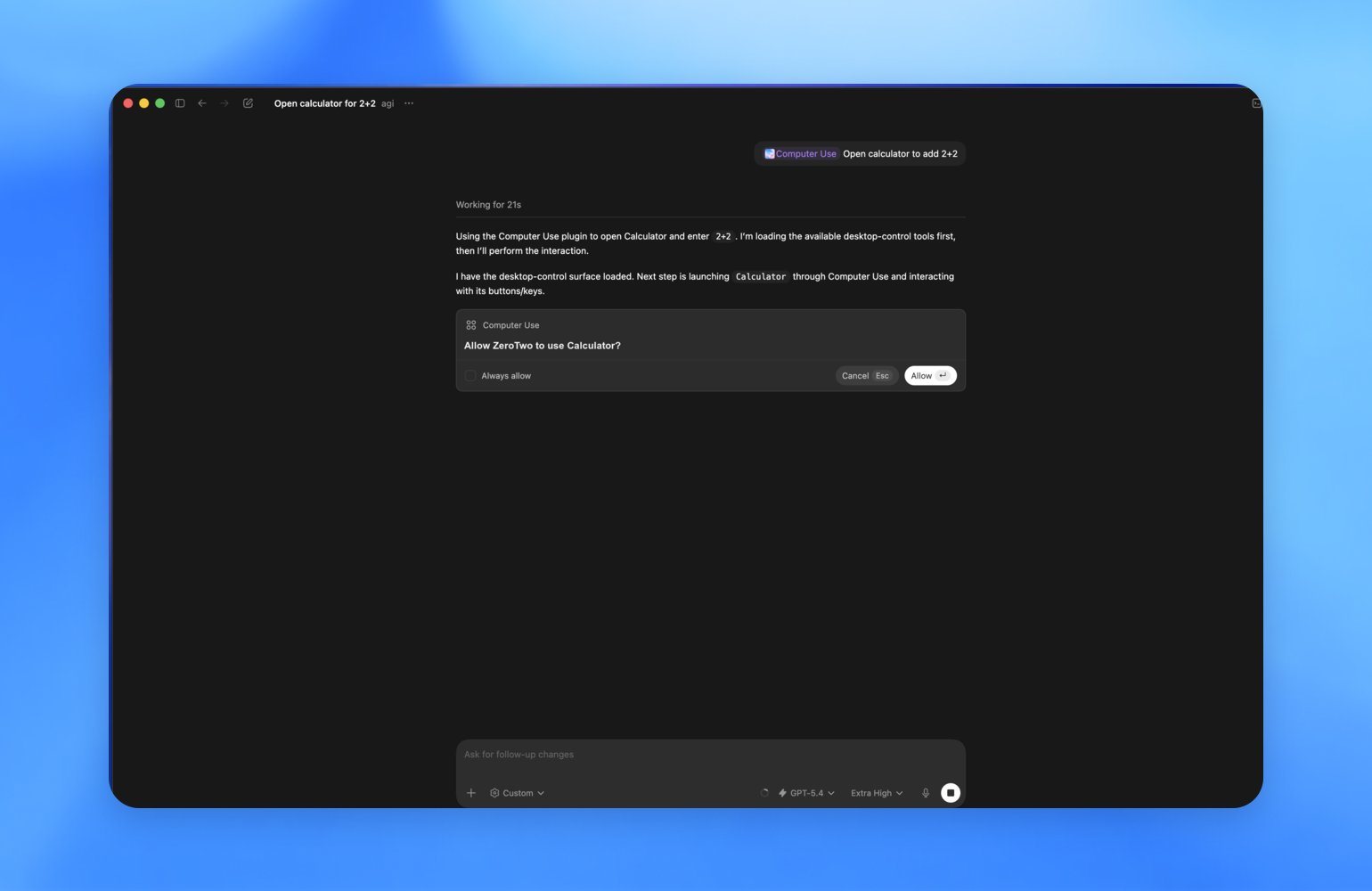 ZeroTwo may also ask for permission before taking sensitive or disruptive actions.
If ZeroTwo can't see or control an app, open **System Settings > Privacy &
Security** and check **Screen Recording** and **Accessibility** for **ZeroCode
Computer Use** on macOS. On Windows, make sure the target app is visible in the
active desktop session.
On Windows, Computer Use stores persistent app decisions in
`$ZEROTWO_HOME/config.toml`. List the apps that Computer Use can open without
prompting:
```toml theme={null}
[computer_use.windows]
always_allowed_app_ids = ["mspaint.exe"]
```
Use the app identifier that Windows Computer Use reports, such as an executable
name for a desktop app or an app user model ID for a packaged app. ZeroTwo
prompts for apps that aren't in the list. To revoke a saved decision, remove
the app from **Settings > Computer Use > Always allow**.
This table stores local Computer Use decisions. It's separate from the
admin-enforced `requirements.toml`, where administrators can disable Computer
Use with `[features].computer_use = false`. Older
`$ZEROTWO_HOME/computer-use/config.toml` allow-list entries are migrated into the
current setting; its `denied` list isn't part of the current policy schema.
## Locked use
Locked use is for macOS. On Windows, Computer Use works in the foreground.
Locked use lets ZeroTwo use Computer Use after your Mac locks, but only after
you enable it. Use it when a ZeroTwo task needs to use desktop apps from a
connected device after the Mac locks.
When you enable locked use, ZeroTwo installs an Apple
[authorization plug-in](https://developer.apple.com/documentation/security/authorization-plug-ins)
that participates in the macOS unlock flow.
Locked use is intentionally narrow. It's not a general-purpose remote-unlock
path for your Mac, and it doesn't let other apps or local processes unlock the
computer.
To use locked use:
1. Open **Settings > Computer Use** in the app.
2. Enable locked use.
3. Start a task that uses Computer Use from a connected device after your Mac's
screen has locked.
When a ZeroTwo task accesses an app via Computer Use after your Mac locks, ZeroTwo
temporarily unlocks the Mac while blocking local use and preserving the locked
screen protections. Before unlocking, ZeroTwo checks whether the unlock attempt is
for an active, trusted Computer Use turn. Outside that short-lived window, ZeroTwo
denies the unlock and asks you to unlock manually if needed.
Locked use includes safeguards:
* The authorization window is short-lived and scoped to the current unlock
attempt.
* Automatic unlock is available only to ZeroTwo during active Computer Use turns.
* ZeroTwo covers every display while the desktop is temporarily unlocked.
* If ZeroTwo detects local keyboard or pointer input, it relocks the Mac and
pauses automatic unlock until you unlock it manually.
## Safety guidance
With Computer Use, ZeroTwo can view screen content, take screenshots, and interact
with windows, menus, keyboard input, and clipboard state in the target app.
Treat visible app content, browser pages, screenshots, and files opened in the
target app as context ZeroTwo may process while the task runs.
Keep tasks narrow and stay present for sensitive flows:
* Give ZeroTwo one clear target app or flow at a time.
* You can stop the task or take over your computer at any time.
* Keep sensitive apps closed unless they're required for the task.
* On Windows, expect ZeroTwo to take over foreground input while it works; use a
secondary device, a VM, or stop the task before using that desktop yourself.
* Avoid tasks that require secrets unless you're present and can approve each
step.
* Review app permission prompts before allowing ZeroTwo to use an app.
* Use **Always allow** only for apps you trust ZeroTwo to use automatically in
future tasks.
* Stay present for account, security, privacy, network, payment, or
credential-related settings.
* Cancel the task if ZeroTwo starts interacting with the wrong window.
If ZeroTwo uses your browser, it can interact with pages where you're already
signed in. Review website actions as if you were taking them yourself: web pages
can contain malicious or misleading content, and sites may treat approved clicks,
form submissions, and signed-in actions as coming from your account. To keep
using your browser while ZeroTwo works, ask ZeroTwo to use a different browser.
The feature can't automate terminal apps or ZeroTwo itself, since automating them
could bypass ZeroTwo security policies. It also can't authenticate as an
administrator or approve security and privacy permission prompts on your
computer.
File edits and shell commands still follow ZeroTwo approval and sandbox settings
where applicable. Changes made through desktop apps may not appear in the review
pane until they're saved to disk and tracked by the project. Your ZeroTwo data
controls apply to content processed through ZeroTwo, including screenshots taken
by Computer Use.
ZeroTwo may also ask for permission before taking sensitive or disruptive actions.
If ZeroTwo can't see or control an app, open **System Settings > Privacy &
Security** and check **Screen Recording** and **Accessibility** for **ZeroCode
Computer Use** on macOS. On Windows, make sure the target app is visible in the
active desktop session.
On Windows, Computer Use stores persistent app decisions in
`$ZEROTWO_HOME/config.toml`. List the apps that Computer Use can open without
prompting:
```toml theme={null}
[computer_use.windows]
always_allowed_app_ids = ["mspaint.exe"]
```
Use the app identifier that Windows Computer Use reports, such as an executable
name for a desktop app or an app user model ID for a packaged app. ZeroTwo
prompts for apps that aren't in the list. To revoke a saved decision, remove
the app from **Settings > Computer Use > Always allow**.
This table stores local Computer Use decisions. It's separate from the
admin-enforced `requirements.toml`, where administrators can disable Computer
Use with `[features].computer_use = false`. Older
`$ZEROTWO_HOME/computer-use/config.toml` allow-list entries are migrated into the
current setting; its `denied` list isn't part of the current policy schema.
## Locked use
Locked use is for macOS. On Windows, Computer Use works in the foreground.
Locked use lets ZeroTwo use Computer Use after your Mac locks, but only after
you enable it. Use it when a ZeroTwo task needs to use desktop apps from a
connected device after the Mac locks.
When you enable locked use, ZeroTwo installs an Apple
[authorization plug-in](https://developer.apple.com/documentation/security/authorization-plug-ins)
that participates in the macOS unlock flow.
Locked use is intentionally narrow. It's not a general-purpose remote-unlock
path for your Mac, and it doesn't let other apps or local processes unlock the
computer.
To use locked use:
1. Open **Settings > Computer Use** in the app.
2. Enable locked use.
3. Start a task that uses Computer Use from a connected device after your Mac's
screen has locked.
When a ZeroTwo task accesses an app via Computer Use after your Mac locks, ZeroTwo
temporarily unlocks the Mac while blocking local use and preserving the locked
screen protections. Before unlocking, ZeroTwo checks whether the unlock attempt is
for an active, trusted Computer Use turn. Outside that short-lived window, ZeroTwo
denies the unlock and asks you to unlock manually if needed.
Locked use includes safeguards:
* The authorization window is short-lived and scoped to the current unlock
attempt.
* Automatic unlock is available only to ZeroTwo during active Computer Use turns.
* ZeroTwo covers every display while the desktop is temporarily unlocked.
* If ZeroTwo detects local keyboard or pointer input, it relocks the Mac and
pauses automatic unlock until you unlock it manually.
## Safety guidance
With Computer Use, ZeroTwo can view screen content, take screenshots, and interact
with windows, menus, keyboard input, and clipboard state in the target app.
Treat visible app content, browser pages, screenshots, and files opened in the
target app as context ZeroTwo may process while the task runs.
Keep tasks narrow and stay present for sensitive flows:
* Give ZeroTwo one clear target app or flow at a time.
* You can stop the task or take over your computer at any time.
* Keep sensitive apps closed unless they're required for the task.
* On Windows, expect ZeroTwo to take over foreground input while it works; use a
secondary device, a VM, or stop the task before using that desktop yourself.
* Avoid tasks that require secrets unless you're present and can approve each
step.
* Review app permission prompts before allowing ZeroTwo to use an app.
* Use **Always allow** only for apps you trust ZeroTwo to use automatically in
future tasks.
* Stay present for account, security, privacy, network, payment, or
credential-related settings.
* Cancel the task if ZeroTwo starts interacting with the wrong window.
If ZeroTwo uses your browser, it can interact with pages where you're already
signed in. Review website actions as if you were taking them yourself: web pages
can contain malicious or misleading content, and sites may treat approved clicks,
form submissions, and signed-in actions as coming from your account. To keep
using your browser while ZeroTwo works, ask ZeroTwo to use a different browser.
The feature can't automate terminal apps or ZeroTwo itself, since automating them
could bypass ZeroTwo security policies. It also can't authenticate as an
administrator or approve security and privacy permission prompts on your
computer.
File edits and shell commands still follow ZeroTwo approval and sandbox settings
where applicable. Changes made through desktop apps may not appear in the review
pane until they're saved to disk and tracked by the project. Your ZeroTwo data
controls apply to content processed through ZeroTwo, including screenshots taken
by Computer Use.